


Session Descriptions - Understanding the different types of organized play
Drills and Skills – This is an opportunity to work on technique and game strategy through drills. A great way to improve your game.
KING or QUEEN of the Court

The Structured Level Play format is a good option for handling sessions where there is a wide range of skill levels between players.
Structured level play begins with players being assigned to courts based on their skill rating. If you don't have a rating, you will start at 2.5. The more advanced players will play on Courts 5 & 6; beginners will play on Court 1; while intermediate players will be spread across Courts 3-4 with the more skilled on Court 4 and less skilled on Court 3.
Games will be timed – 13 minutes. When the buzzer sounds, finish the rally and the team with the highest number of points will be the winner. If there is a tie, play one more rally and the winner of the rally is the winner of the game.
Round 1 – start when the Host announces it is time to start. Stop when the 13 minute buzzer sounds.
For Round 2, the winners will move to the next higher skill level (higher numbered court) and split onto opposite sides of the net; the losers will move to the next lower skill level court (lower numbered court) and split.
Follow the same process of splitting and moving up/down for additional rounds.
If there are more than 2 people wishing to play on a specific court, the extra players (no more than two waiting paddles behind any one court) will place their paddles along the back wall of the court (not the first or last court) on which they wish to play. When the initial 4 players have completed their game, the next two people with paddles at the wall will split and step onto the court. The losing team moving down (to a lower numbered court) will sit out a game if there are any paddles waiting to come into play. No paddles are allowed behind the first or last courts.

Round Robin (RR) - *SKILL SPECIFIC – 2 hours Play IS competitive. Players are given a number and rotate into a different team for each game. The typical format for the games are timed (12 minutes per game to create flow); however, if there are fewer teams the games are played out and then the rotation occurs. **IF you do not use the SIGN-up Genius you MAY not get in. Plan ahead if you can! Registration is required on Sign-up Genius. Be sure you are on the SIGN-UP Genius LIST to be included on this.
Round Robin Partner Play – 2 hours Simply partner up with a friend or loved one and play as a pair for the full 2 hour segment. Format follows the above SKILL SPECIFIC RR. The Sign-up Genius organizer will determine the format for play rotation depending on the groups’ skill levels and attendance. Each team is assigned a number. Typically this is two separate tiers.
Round Robin (RR) - SOCIAL / Recreational – 2 hours This social and fun style of play is for all skill levels to mix-in. *NO Smashing or Hard Driving if there is anyone on the court with you at a lower skill level! The intent is to create a FUN environment not aggressive. IF you want a more competitive game, choose the RR for your Skill-Level.
- SKILL SPECIFIC LEVEL Play* – These sessions have eligibility criteria for play. You will need either a Salmon Arm Pickleball Club rating, or a UTPR via USAPA, or CTPR via Pickleball Canada (PCO) achieved in tournament play. This is a chance to play with like-skilled players.
Open Play Description (Paddles Up Format)
Open play is one of the most popular and effective ways to organize activity at a pickleball club because it balances structure with flexibility while keeping the focus on fun, inclusion, and lots of time on the court.
A key benefit of open play is that it creates a more inclusive environment. Players of different backgrounds, experiences, and skill levels are welcomed and given opportunities to participate. By encouraging an intermix of players, newer players are not isolated and experienced players are not limited to the same partners or opponents
each time they play. Open play also supports player development through informal mentoring. When players of varying abilities share the court, learning happens naturally during play, helping newer or less experienced members improve their skills and confidence.
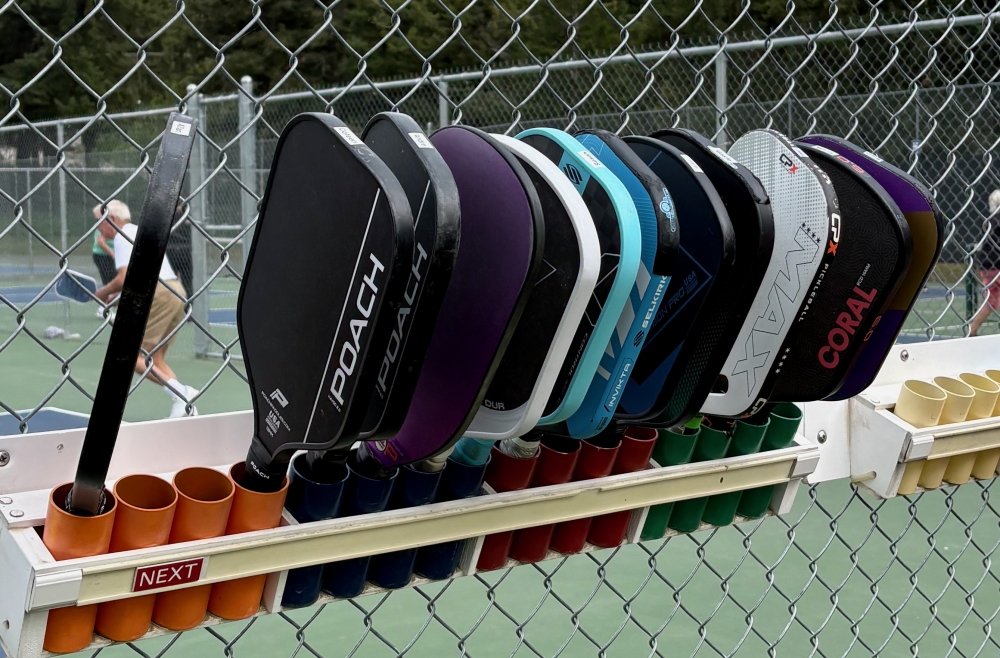
To keep games balanced and enjoyable, open play is typically organized using a paddle stacking system. Players place their paddles in the racks to indicate they are waiting to play. If skill levels vary widely, courts can be divided into groupings such as beginner, intermediate, and advanced. This structure allows players to compete with others of similar ability while still maintaining flexibility to move between groups as their skills
develop.
When a game finishes, the next four paddles in the stack are selected to form the next match. This system keeps rotations fair and transparent, minimizes confusion, and ensures everyone gets equal opportunities to get on the court.
Unlike the round robin format, you can arrive whenever you want, leave whenever you want and rest whenever you want, without disturbing play. When you place a paddle in the holder it indicates you are ready to hit the courts. Please don’t place your paddle there if you need a rest or are going to the bathroom!
Overall, open play is an efficient, inclusive, and social way to organize pickleball. It maximizes court usage, encourages interaction among players, supports skill development through mentoring, and creates a welcoming environment for players of all levels.